
Keto vs Ketovore vs Carnivore: What’s the Difference?
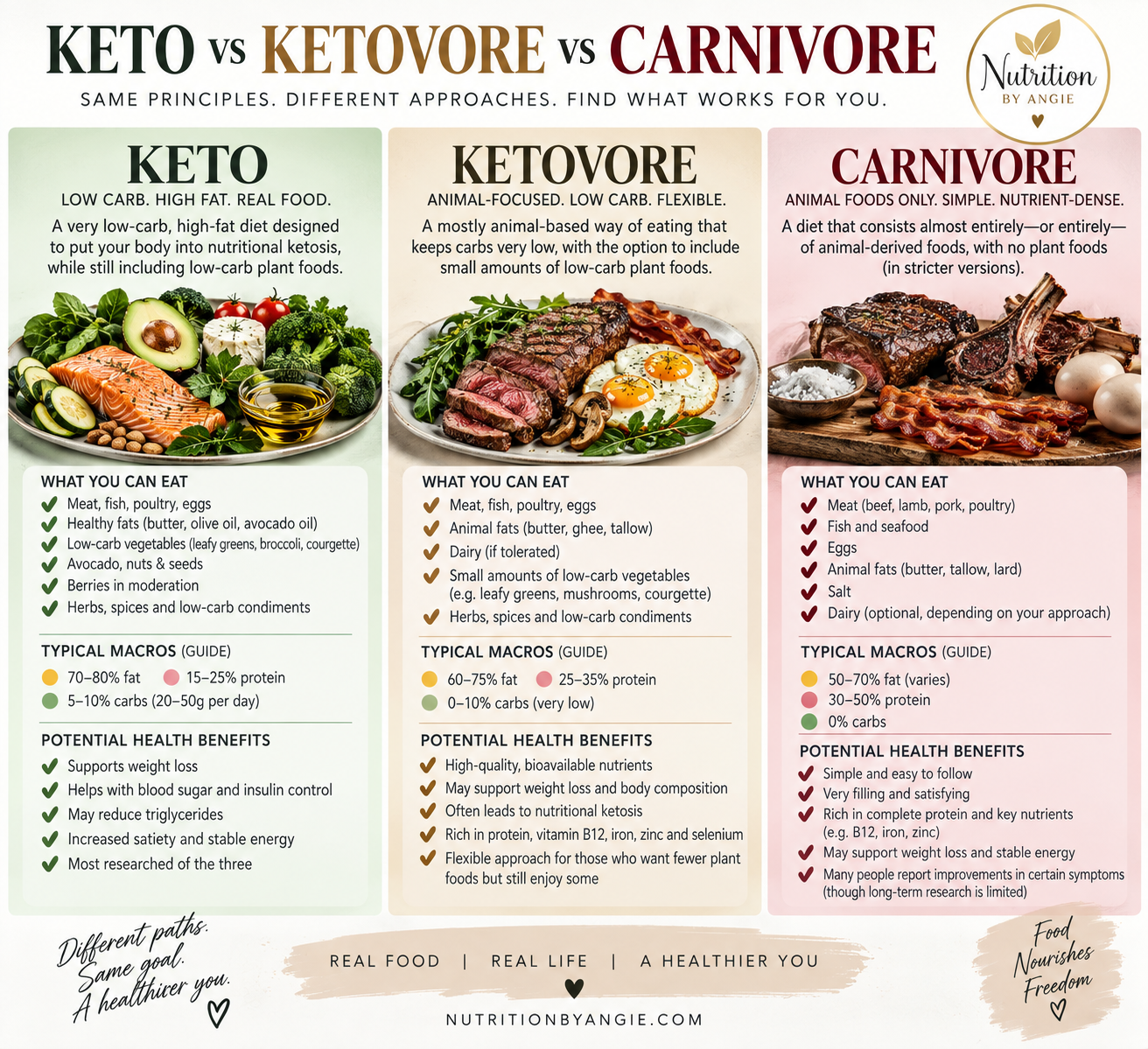
If you’re interested in low-carb eating, you’ve probably come across the terms keto, ketovore and carnivore. While these ways of eating have plenty in common, they aren’t exactly the same.
All three approaches generally reduce carbohydrate intake and place a greater emphasis on protein and fat. The biggest difference is how restrictive they are and how much plant food they include.
A ketogenic diet can contain plenty of low-carb vegetables, nuts, seeds and other plant foods. Ketovore moves closer towards an animal-based way of eating, while carnivore typically removes almost all plant foods entirely.
So, which is which? Let’s break it down.
What Is the Keto Diet?
The ketogenic diet, usually called keto, is a very-low-carbohydrate eating pattern designed to encourage the body to enter nutritional ketosis.
Normally, the body can use glucose from carbohydrates as a major energy source. When carbohydrate intake becomes very low, the liver increases production of ketone bodies from fatty acids, which can then be used as an alternative fuel.
A ketogenic diet commonly limits carbohydrates to around 20–50 grams per day, although the amount needed to maintain ketosis varies between individuals.
What Can You Eat on Keto?
A keto diet might include:
Meat and poultry
Fish and seafood
Eggs
Cheese and full-fat dairy
Olive oil, avocado oil and other fats
Avocados
Low-carb vegetables
Leafy greens
Nuts and seeds
Berries in moderate portions
Low-carb sauces, herbs and seasonings
This makes keto the most flexible of the three approaches.
Potential Benefits of Keto
The ketogenic diet is also the best researched of the three.
Research suggests ketogenic and carbohydrate-restricted diets can help with weight loss and glycaemic control, particularly in people with overweight, obesity or type 2 diabetes. Some studies also find reductions in triglycerides, glucose and insulin. However, individual responses vary, and LDL cholesterol can increase in some people.
Ketogenic diets also have a long-established clinical role in the treatment of certain forms of drug-resistant epilepsy, although therapeutic ketogenic diets are medically supervised and are different from simply following keto for weight management.
Another reason some people enjoy keto is satiety. Meals containing adequate protein and fat can be filling, while ketosis itself may influence appetite.
Keto may therefore appeal to someone who wants the metabolic effects of carbohydrate restriction while still enjoying vegetables and other low-carb plant foods.
What Is a Ketovore Diet?
Ketovore sits somewhere between keto and carnivore.
There isn’t one universally accepted scientific definition of ketovore. It is primarily a term used within low-carb communities to describe a very-low-carbohydrate, animal-focused diet that still allows some plant foods.
Think of it as:
Keto → Ketovore → Carnivore
As you move across that spectrum, animal foods generally become more prominent and plant foods become more limited.
What Do You Eat on Ketovore?
A ketovore diet may be based primarily around:
Beef
Venison
Lamb
Pork
Chicken
Fish and seafood
Eggs
Butter or ghee
Cheese and other dairy, if tolerated
Animal fats
Small amounts of low-carb plant foods may still be included, such as:
Avocado
Leafy greens
Mushrooms
Courgette
Herbs
Spices
Garlic
Low-carb condiments
Exactly where keto ends and ketovore begins isn't clearly defined.
That flexibility is actually one of the attractions of the approach.
Potential Benefits of Ketovore
Because ketovore hasn't been well studied as a distinct diet, we cannot confidently claim that it has unique health benefits of its own.
Many of its potential advantages instead come from characteristics shared with ketogenic or high-protein diets.
For example, a properly planned ketovore diet can be rich in high-quality protein, which helps maintain muscle mass and contributes to satiety.
Animal foods can also provide highly bioavailable nutrients including:
Vitamin B12 • iron • zinc • selenium • complete protein
Depending on how low carbohydrate intake becomes, some people following ketovore may also enter nutritional ketosis and potentially experience some of the metabolic effects associated with a ketogenic diet.
The major practical advantage is flexibility: someone who enjoys eating predominantly animal foods doesn't necessarily have to eliminate every vegetable, herb or seasoning to fit a ketovore approach.
What Is the Carnivore Diet?
The carnivore diet takes carbohydrate restriction much further.
It consists almost entirely—or, in stricter versions, entirely—of foods derived from animals.
A typical carnivore diet may include:
Beef
Venison
Lamb
Pork
Poultry
Fish
Seafood
Eggs
Animal fats
Salt
Some versions also include dairy foods such as cheese, cream and butter.
Stricter approaches may consist primarily of meat, salt and water.
Fruit, vegetables, grains, legumes, nuts and seeds are generally excluded.
Potential Benefits of the Carnivore Diet
This is where it's particularly important to separate personal experiences from established scientific evidence.
People following carnivore diets commonly report benefits such as increased satiety, weight loss or improvements in certain symptoms.
There are also plausible benefits to eating plenty of nutrient-dense animal foods. Meat provides complete protein alongside nutrients such as vitamin B12, iron and zinc.
However, scientific research specifically examining the carnivore diet remains very limited.
A recent review of the available human evidence found reports of weight reduction, increased satiety and possible improvements in some metabolic markers. However, the researchers also highlighted the small number and generally low quality of available studies.
So while carnivore is an interesting and increasingly popular nutritional approach, its long-term health effects are far less established than those of ketogenic or conventional low-carbohydrate diets.
Keto vs Ketovore vs Carnivore at a Glance
KETO
Very low carbohydrate
Moderate to high fat
Adequate protein
Includes low-carb plant foods
Designed to promote nutritional ketosis
Most researched of the three
KETOVORE
Very low carbohydrate
Animal-food focused
High in protein
Small amounts of plant foods may be included
May produce nutritional ketosis
More flexible than strict carnivore
CARNIVORE
Extremely low or virtually zero carbohydrate
Animal foods form almost the entire diet
Generally high in protein
Plant foods are eliminated or almost eliminated
Often ketogenic, although ketosis depends on overall macronutrient intake
Long-term scientific evidence remains limited
Is Carnivore Automatically Keto?
Not necessarily.
This is one of the most common misconceptions.
A carnivore diet contains very little carbohydrate, but low carbohydrate intake isn't the only factor determining blood ketone levels.
Someone eating large quantities of lean protein with relatively little fat may have different ketone levels from someone following a higher-fat carnivore diet.
This means:
Carnivore describes the foods you eat.
Ketogenic describes the metabolic goal of producing nutritional ketosis through carbohydrate restriction.
The two frequently overlap, but they aren't identical.
What About Protein?
Protein is important on all three diets.
It provides the amino acids your body needs for muscles, enzymes, hormones and many other essential processes.
High-protein meals can also be particularly satisfying, which may make it easier for some people to naturally reduce overall food intake.
Foods such as eggs, fish, beef, chicken and venison provide complete protein containing all nine essential amino acids.
You don't need to fear protein simply because you're following keto.
What About Fat?
This is another area where the three approaches can differ considerably.
Traditional ketogenic diets tend to be relatively high in fat because fat replaces much of the energy previously supplied by carbohydrates.
Ketovore can range from moderate to high fat.
Carnivore can also vary dramatically depending on whether someone chooses fatty steaks, eggs and butter or primarily lean meat.
Importantly, more fat isn't automatically better.
The type and quantity of fat still matter, particularly for cardiovascular health.
Research on ketogenic diets shows an interesting combination of effects: triglycerides often decrease, while LDL cholesterol can increase in some individuals.
That is why people following a high-fat keto or carnivore diet—particularly anyone who already has elevated cholesterol—shouldn't assume that feeling good means their cardiovascular markers are automatically improving.
Blood tests matter.
Which Approach Is the Most Flexible?
If you imagine these diets as a spectrum, it becomes much easier:
KETO → KETOVORE → CARNIVORE
Keto gives you the greatest variety of plant foods.
Ketovore shifts the emphasis towards meat, eggs, fish and other animal foods while retaining some flexibility.
Carnivore is the most restrictive and removes almost all plant foods.
There doesn't have to be a competition between them.
The best nutritional approach depends on your goals, preferences, health, blood results, medical history and, importantly, whether you can actually maintain the way of eating.
The Bottom Line
Keto, ketovore and carnivore all share one major characteristic: carbohydrates are significantly restricted.
But they aren't interchangeable.
Keto focuses on carbohydrate restriction and nutritional ketosis while allowing a wide variety of low-carb plant and animal foods.
Ketovore is an animal-focused version of low-carb eating that bridges the gap between keto and carnivore.
Carnivore takes the approach furthest by eating almost exclusively animal-derived foods.
Of the three, keto currently has considerably more scientific research behind it. Ketovore hasn't been adequately studied as its own dietary pattern, while research specifically examining long-term carnivore diets remains limited.
Whichever approach you choose, food quality still matters.
Focus on nourishing foods, adequate protein and a way of eating that supports your individual needs rather than trying to make your diet fit a label.
Here at Nutrition by Angie, you'll find keto recipes, ketovore recipes and carnivore recipes to help make low-carb eating simple, satisfying and enjoyable.
PLEASE NOTE: This article is for general educational purposes and isn't a substitute for individual medical or dietary advice. Anyone taking glucose-lowering or blood-pressure medication, or managing a medical condition, should discuss significant carbohydrate restriction with an appropriate healthcare professional.